
Research & Scholarly Work
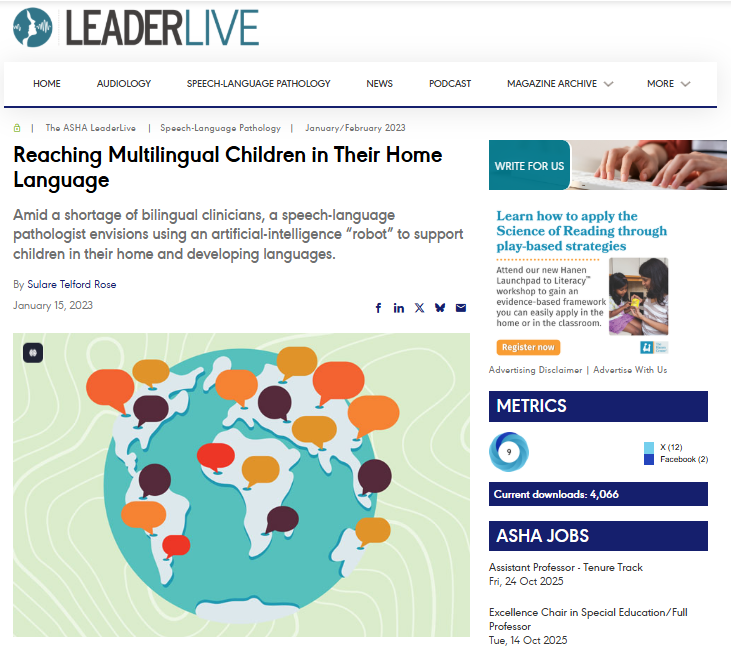
Telford Rose, S. (2023). Reaching Multilingual Children in Their Heritage Language. ASHA Leader.
Abstract: This article discusses strategies for speech‑language pathologists to support multilingual children by using their home languages. It highlights the benefits of intervention in the heritage
language, including improved cognitive and language development and stronger family connections. Practical suggestions are provided for assessment, adapting materials, and involving families in the process. The article emphasizes that fostering the home language is essential for effective and equitable intervention.
Jocelyn, J., & Telford Rose, S. (2025). Using translanguaging as an intervention for Caribbean Creole children. Seminars in Speech and Language, 45(1), 35–48.
Abstract: This tutorial aimed to bridge the gap in the literature by presenting historical and contextual backgrounds on Caribbean Creoles and their speakers while examining the potential benefits and
practical implications of incorporating translanguaging into speech-language intervention for children from Caribbean Creole-speaking backgrounds. Utilizing the principles of translanguaging, this tutorial
introduces the Translanguaging Speech-Language Intervention Framework (TSI Framework) for clinical speech-language-hearing intervention. The TSI is proposed as a useful tool for working with
Caribbean Creole children, though it is applicable to other groups as well. Incorporating TSI into intervention with Caribbean Creole speakers allows for bilingual children to develop and grow their unitary complex language system, equips service providers with a tool to provide culturally responsive service, fosters a strength-based approach for bilingual intervention and assessment, supports families and encourages home language maintenance, and promotes and advocates for linguistic justice.
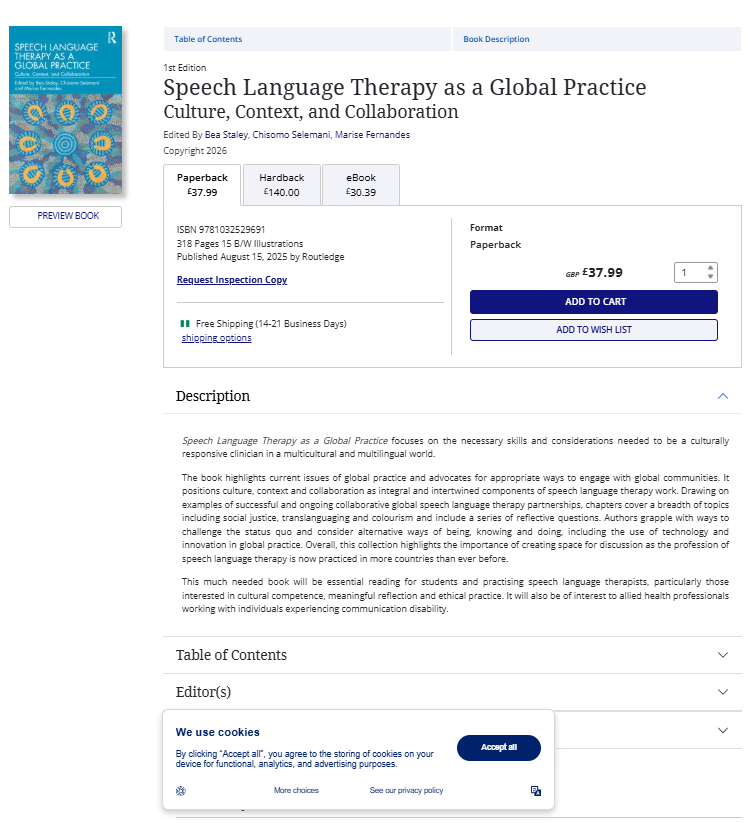
Telford Rose, S., Alkihani, M., & Bruce, A. (2025). Empowering Multilingual Voices: Translanguaging and AI as Catalysts for Innovation in Speech-Language Pathology. In K. Selmani & B. Staley (Eds.), Speech-Language Pathology as a Global Practice. Routledge.
Description: Speech Language Therapy as a Global Practice focuses on the necessary skills and considerations needed to be a culturally responsive clinician in a multicultural and multilingual world.
The book highlights current issues of global practice and advocates for appropriate ways to engage with global communities. It positions culture, context and collaboration as integral and intertwined
components of speech language therapy work. Drawing on examples of successful and ongoing collaborative global speech language therapy partnerships, chapters cover a breadth of topics including social justice, translanguaging and colourism and include a series of reflective questions.
Authors grapple with ways to challenge the status quo and consider alternative ways of being, knowing and doing, including the use of technology and innovation in global practice. Overall, this collection highlights the importance of creating space for discussion as the profession of speech language therapy is now practiced in more countries than ever before.
This much needed book will be essential reading for students and practising speech language therapists, particularly those interested in cultural competence, meaningful reflection and ethical practice. It will also be of interest to allied health professionals working with individuals experiencing communication disability
Jocelyn, J., Elie, M., Harris, O., Lucker, J., Perry, V., & Telford Rose, S. (2024). American Journal of Speech-Language Pathology
Purpose: The study sought to understand Haitian parents’ perspectives on heritage language maintenance with typically developing children.
Jocelyn, J., Elie, M., Harris, O., Lucker, J., Perry, V., & Telford Rose, S. (2024). The Perspective of Haitian Parents on Heritage Language Maintenance in Children with Speech-Language Disorders. Perspectives of the ASHA Journals.
Purpose: This study is part of a larger study that explores the beliefs and attitudes of Haitian parents in the United States regarding heritage language maintenance. The study sought to understand Haitian parents’ perspective of heritage language maintenance when the parent has a child with a communication disorder.
Telford Rose, S., & Myers, J.R. (2024). “Impact of Post-Traumatic Stress on Cognitive- Communication in Bilingual Children and Adults.” In (Ed.) Y. Hyter. Routledge.
Abstract: Studies have shown that trauma can negatively affect an individual’s cognitive function, including cognitive processes necessary for language development and communication. However, the effect of trauma on the cognitive communication of multilingual children and adults has been vastly understudied. This chapter addresses this critical gap by exploring the relationship between trauma and language among multilingual individuals. Important concepts in this context such as raciolinguistics and translanguaging will also be discussed. Lastly, this chapter introduces the multicultural UPLIFT model, a recommended approach for speech-language-hearing professionals when providing culturally responsive trauma-informed care for multilingual individuals.
Telford Rose, S., DeLisser, T., & Vanta, A. (2024). “Assessment of Creole Languages in the Absence of Norms: A Case on Guyanese Creoles.” In A Guide to Global Language Assessment: A Lifespan Approach. Routledge.
Abstract: This chapter seeks to provide a background on creole languages, particularly those that emerged out of the colonial context, with implications for assessing children in the field of speech-
language pathology. In the absence of developmental normatives, it is challenging to evaluate the linguistic competencies of children who speak creole languages. However, this chapter provides a framework for assessing the morphosyntactic features of creole languages in children with Guyanese Creole (GC; a Caribbean Creole with English as its lexifier) as a case study. In the absence of norms, clinicians must be able to identify language disorders in children and avoid misdiagnosis by learning about the linguistic rules of the language and by borrowing the framework used for assessing languages where normatives or assessment tools do not exist. While this is not ideal, it can lend to the
reduction of misdiagnosis. Since culture and language are so intricately related and one informs the other, the chapter also provides a cursory background on Guyanese cultural norms.
Myers, J.R., & Telford Rose, S. (2022). “Trauma Impact on Language Skills in Bilingual Adults: A Case for Trauma-Informed Services.” HPHR formerly the Harvard Public Health Review.
Abstract: This study explores the reported impact of trauma on language skills in bilingual adults and show language fluency in both languages spoken may be impacted by traumatic experiences
including COVID-19.
Telford Rose, S.; Payne, K.; DeLisser, T.; Harris, O.;Elie, M. (2020). A Comparative Phonological Analysis of Guyanese Creole and Standard American English: A Guide for Speech-Language Pathologists. Perspectives of ASHA Journals.
Purpose: Speech-language pathologists (SLPs) are responsible for differentially diagnosing a speech or language difference versus disorder. However, in the absence of data on particular cultural or
linguistic groups, misdiagnosis increases. This study seeks to bridge the gap in available resources for SLPs focusing on the phonological features of Guyanese Creole (GC), a Caribbean English–lexified Creole. This study addresses the following question: What are the differences between the phonological features of GC and Standard American English (SAE), which may potentially cause SLPs to misdiagnose Guyanese speakers?
Telford Rose, S. (2021) Becoming Bilingual. Resound: A Publication of the National Black Association of Speech-Language and Hearing (NBASLH).

Telford Rose, S. (2019). IDK if U Can Read This: Handling ‘Textese’ in Treatment? (May,2019). ASHA Leader.
Abstract: This article examines contemporary challenges and approaches in speech‑language pathology practice and presents evidence‑based strategies for enhancing client outcomes. It underscores the importance of ongoing professional development and adaptive service delivery to meet diverse client needs in the field.
© Copyright Sulare’s Site 2025